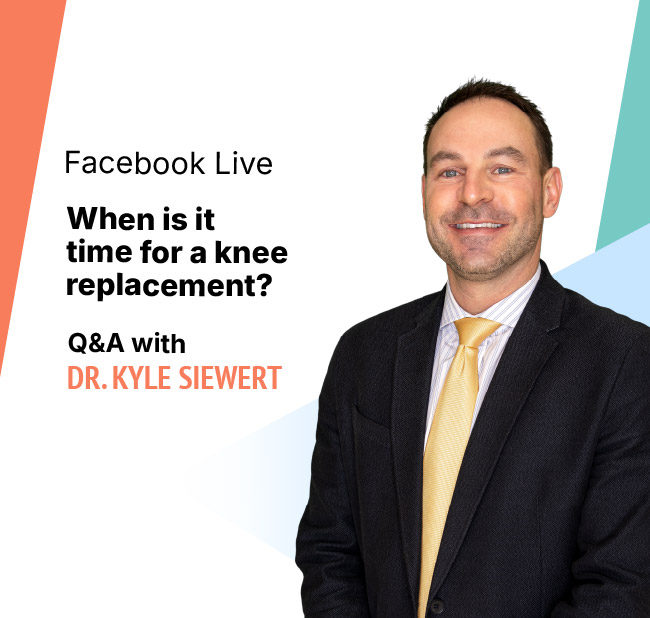
Video transcript
Moderator: Welcome in everyone. Henry Community Health board certified orthopedic surgeon Dr. Kyle Siewert is joining us tonight to walk you through one of the most common questions we hear, “How do I know when it’s time for a knee replacement?” Make sure you drop your questions in the comments as we go along and we’ll answer as many as we can. Welcome, Dr. Siewert.
Dr. Siewert: Hi, thanks Luci and thanks everyone for joining. As Luci mentioned, my name is Kyle Siewert. I’m an orthopedic surgeon here at Henry Community Health – Henry County Center for Orthopedic Surgery and Sports Medicine.
We’re here to talk about knee replacement a little bit tonight, but also, you know, making that choice as to how do we know when it’s time to consider that? I do around 200 knee replacements per year, but I treat a lot more patients than that without surgery. And so just want to have a chance to talk tonight a little bit about making that decision as to what’s appropriate.
So before we get started, you’re going to see a poll pop up. Just kind of indicating if you have seen a knee specialist before and so if you don’t mind take a moment to answer that poll and then we’ll get started with our talk.
(Brief pause for the poll)
Dr. Siewert: Thank you. All right. So, when people come to see me for knee pain or to talk about their knee concerns, it’s usually not a screening evaluation. Most of the time people have been having some problems or some issues and they’re concerned about how it’s impacting their lives. And so, they’ll come to talk about it.
When they come there’s a lot of questions that I have for them, and we’ll have conversations about the way it impacts their life. But I really want to know a lot about how often the symptoms are occurring, and how severe they are. Maybe what they’ve tried to mitigate those symptoms, what’s worked, and maybe what’s not working.
So all these things will help us make a decision on what kinds of things we’re concerned about. After that conversation and discussion about the knee pain or knee symptoms, an exam – a physical exam of the knee is really important. And so, I’m going to want to know a lot about the knee. Most importantly probably you know, range of motion.
I’m going to evaluate the knee. We’re going to test stability of the ligaments to see if there’s anything that’s concerning about what we find on that, swelling, effusion, within a knee is concerning we kind of talk about what leads to those kind of findings.
I want to see how people walk, kind of assess the gate pattern. Then there’s certain special tests that we’ll do on a knee for certain types of injuries. And so we’ll kind of go through all the physical exam to help cue in on what might be going on after an exam. Really for sure one of the foundations of trying to assess a knee issue is an X-ray. And we’ll do those here in the office.
Standing X-rays are definitely important. They help give us a sense of what the state of the knee is with normal loading and activity in life. And so, those are really important to find out what might be going on. If a knee X-ray is really pretty good and there’s not a lot of concern with that, sometimes that’s when an MRI or some other specialized testing might be indicated to help see structures that might not be present to evaluate on an X-ray.
So, after we’ve kind of done those things, we’re going to kind of talk about the most likely source of the knee problem or the knee pain and what might be limiting a patient.
So, throughout this, if there are questions or comments, be happy to try to answer those and address any concerns or questions you all might have. So, one question that came in is, “is knee replacement my only option for knee pain or knee problems?”
And for sure that answer is no. But we have to kind of decide what other options might be beneficial to help people. And so, even if we’re talking like tonight mostly about knee arthritis where the cartilage has worn down and and the knee is not functioning well, we still have lots of conservative things that we can try and and in fact we want to make sure and try before we get to that point where where knee replacement is the best option.
Some of those things include, you know, good supportive shoes with a nice sole to help cushion you from the hard ground, low impact exercise. We need to try to keep our muscles as strong as possible to kind of overcome a joint that’s not as optimal as it should be.
Medications, sometimes things like over-the-counter anti-inflammatories or even prescription arthritis medications, Tylenol during the day. We certainly want to try to avoid narcotics as that won’t help with the arthritis process and has other other problems associated with it.
Weight loss can help the impact on a knee, but unfortunately it doesn’t change the overall arthritis process. So, it’s an option to try to help with the symptoms.
Physical therapy can play a role, depending on how progressed the arthritis might be.
Bracing sometimes can help.
Activity modification to avoid the things that hurt the knee.
And even sometimes depending on what we find on X-rays and what other things might be going on, sometimes there can be a limited role for an arthroscopy, if the problems are more with a meniscus or something other than the articular cartilage.
So, while these conservative treatments can certainly lessen the symptoms or even sometimes make them kind of go away for a while, none of those things are going to slow or none of those things will stop the process of arthritis.
So, we know it’s progressive. It’s just how long can we keep the knee functioning well and keep a person’s quality of life where they want it to be before considering knee replacement. So once a patient has failed to get to that level without knee replacement, that’s when we’ll have that conversation.
So to just talk a little bit about knee replacement surgery, it is the gold standard as far as being able to restore trustworthy articular surfaces for a patient to function and to gain strength and resume that activity that was not possible before. And while there’s a lot of different variations about knee replacement, such as, you know, the approach, the type of connection of the implants to the bone, the type of bearing surface and what we’re trying to achieve, with how that works, and even which ligaments we can preserve, and and which are not part of a knee replacement.
The overall idea of knee replacement is the same.We’re going to resurface the end of the thigh bone, and then resurface the top of the shin bone, and then underneath the kneecap to basically provide those new surfaces.
So I have a model here. I’ll try to show that the best I can as far as what we just talked about. So with knee replacement where the kneecap is in front, we’re going to remove the bad cartilage on the underside of that kneecap on the end of the thigh bone. We’re going to remove the bad cartilage and the bone spurs that go along with that right off the end of the bone and cover it with this material. And then, same thing on the top of the shin bone. We’re going to remove the bad surface right on the top of that bone. Put this piece back in its place. And now that’s what restores that nice smooth surface for a patient to walk on and have good function without the aggravation of severe arthritis.
So, with knee replacement surgery, it takes a little less than an hour, about an hour to do that procedure. Patients are going to be able to get up and walk on that from day one. And we’re going to have them put all their weight on it. Most people are going to use a walking aid such as a walker for a week or two. And then a cane possibly for a week or two. And mostly by four to six weeks, people are able to walk independently and get around while they’re still dealing with some soreness and swelling, but continuing to improve. It can take a few months to really build that strength and continue to increase the level of activity, but it’s certainly improving week to week.
Another question was just about, you know, how long the surgery takes, which we just kind of alluded to. It’s typically about an hour to do a knee replacement. Some patients do go home the day of the operation, and then others might stay overnight and go home the next day after some therapy.
At this point, I’m happy to kind of address, questions and and comments, but a couple of other questions that I see. Someone asks, “If I get one knee replaced, is it just a matter of time before the other one will need replaced?” And that’s a great question, but in fact, really every joint is unique. And just because you have one bad knee or one knee that needs surgery does not mean the other one will or even in the you know future would need surgery. So it just depends on the symptoms and you know the exam findings and the x-rays, but no and yeah there are definitely people who have two bad knees and might both need replace. But it doesn’t always work like that.
Another question is, “Is there anything I can do to speed up the recovery process?” We’re all trying to get back to the activities we love. And so, that’s certainly a relevant question. And there are things you can do before surgery to kind of help in that recovery. Continuing to work on your stretching and range of motion beforehand is helpful. Trying to build up your muscles as much as you can before surgery will help you in your recovery. And then, definitely good nutrition – lots of protein and taking care of your body as you heal through that process will help in the recovery. But, to some extent, it’s still a biologic process and and we still have to allow the tissues to heal and sometimes we can try to push that too far and if there’s too much activity early on that can lead to some edema or or even drainage which can cause problems in your wound healing. So, there’s a fine balance about getting through that safely and as rapidly as is safe.
Another question, “Are there any side effects to waiting on knee replacement surgery or to putting it off? Will the surgery or the recovery be worse?” And I think that’s another great question. You know, we really want to exhaust conservative measures before we make that decision for surgery. But once it’s clear that this is a progressively worsening problem for a patient there are some downsides to waiting. And I’ll just kind of touch on a couple of those. But one is, as arthritis continues to get worse typically what we see is mobility and range of motion gets worse. And while it’s not always more painful the longer we wait, sometimes it certainly can be, but it doesn’t always have to be. But if our range of motion and function continues to decline, that can have an impact on your recovery because, you know, our muscles and our tendons have a certain amount of excursion and movement allowable. And if you go years and years and not function in that way, it can be really a lot harder to gain that back after having a successful knee replacement. So, that’s one downside of waiting is you want to make sure that you keep as much mobility and range of motion as possible before you have your surgery because it’ll impact your recovery.
The other part is, you know, I’ve certainly had patients who have wanted to wait for lots of reasons and we we try and do that, but there are times when the pain can just go off the charts and become really severe to the point where they can’t work or they can’t do the things that are really important in their day-to-day. And so if we know that we have a severe problem and we have options to correct it, if you can do that before you get into that scenario where the pain is completely limiting you from the important things you need to do, that can be optimal, too. Another reason perhaps not to put it off too long.
Another question I had here was, “I’m young but having a lot of knee pain and what is too young for knee replacement surgery?” And another really good question, and an important one. In the past with knee replacement surgery and the implants that we used, some of the ways that they were manufactured and sterilized could lead to more rapid wear of those parts. You can imagine the millions of cycles in a knee over time. They can show wear and that could lead to failure which means further surgery. But thankfully, in the last 20 years there’s been some significant changes in how some of those parts have been manufactured and sterilized, to now where thankfully we are not seeing those kinds of wear problems like they did in the past. And so, that’s opened the door for us to really have good options to help people keep that lifestyle and the activity level that they want at a younger age. Whereas in the past they might have been told, “Sorry, you’re too young for that kind of surgery and you just have to live with this until you’re older.” So, I don’t really approach it that way. Now, thankfully, some other technology that we have, instead of having to use bone cement to connect the parts to the bone, we now have cementless implants that essentially on the back side of them kind of mimic bone. And so once we prepare the bony surfaces and we place those parts, there the bone is able to actually grow and bond onto those parts which creates a biologic connection, which we believe you know is really more durable and can last a patient’s lifetime. So the point is I guess there’s really no age where I would not consider this as an option for the patient who needs it. We still have to be responsible with those decisions and when it’s appropriate. But definitely when the arthritis process is limiting a patient and they cannot function in the way they want, we have this option to help restore that.
Any other questions there?
[brief pause for questions]
Moderator: Well, we want to take a moment and thank everyone for tuning in this evening. A huge thank you to Dr. Kyle Siewert for sharing all of this information and his expertise with us. We hope you’re walking away with a little more clarity about your options and what the right next steps might look for you. We’d love to hear from you if you’d like a consultation with Dr. Siewert. Just give the office a call. That’s a great first step. Be sure to follow our page so you never miss a future live event. We will begin covering topics like this regularly, all aimed at helping you live and move better. Thanks again for being here and we will see you next time.
Dr. Siewert: Thanks.
Knee pain that won’t go away? Not sure what your next step should be?
For many people with knee arthritis, treatments like physical therapy or cortisone injections can help—for a while. But when that relief fades, it can be hard to know what to do next.
Listen to Dr. Kyle Siewert, a board-certified orthopedic surgeon who has been caring for patients at HCH since 2012, to talk through one of the most common questions patients have: When is it time to consider a knee replacement?
Dr. Siewert will cover:
- Signs it may be time to take the next step
- What alternatives may still be available
- What recovery actually looks like
Ready to talk through your options? Schedule an evaluation with our orthopedic team: https://www.hchcares.org/ortho-get-started/